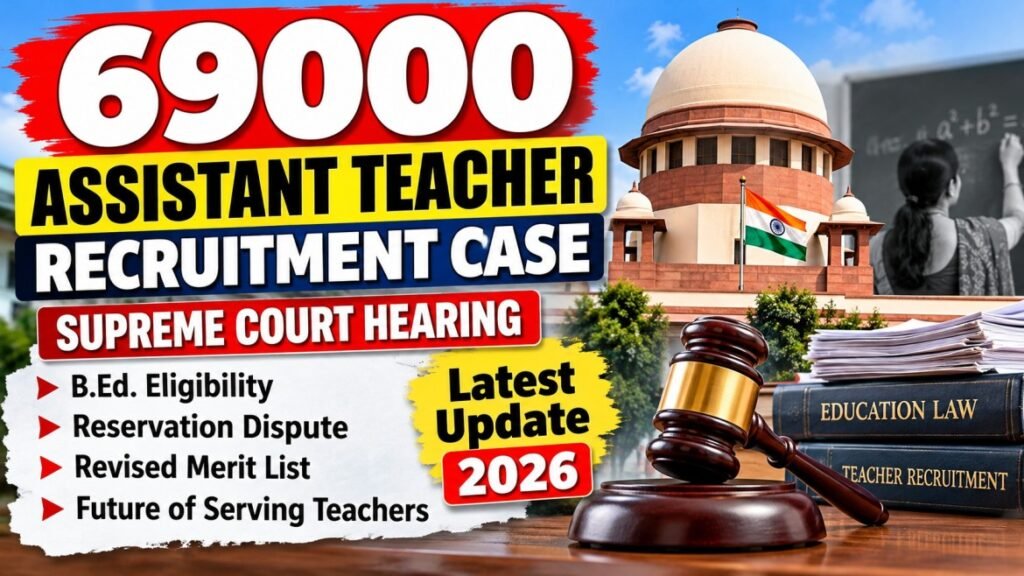
The 69000 Assistant Teacher Recruitment Case in Uttar Pradesh remains an important issue for thousands of teacher aspirants and serving teachers. The case involves allegations of reservation irregularities, the preparation of a revised merit list, and the future of candidates who have already been appointed as assistant teachers.
The Supreme Court has heard arguments from different sides, including selected candidates and those challenging the recruitment process. The main concern is how to protect the rights of eligible candidates while ensuring fairness and legality in the recruitment process.
According to a report published by NDTV on September 17, 2026, the Supreme Court heard arguments concerning the recruitment dispute, including the possible impact on teachers already working in schools. The report also noted that further arguments from candidates affected by the reservation dispute were expected on September 22, 2026. Source: NDTV India
The recruitment dispute has continued through multiple rounds of litigation. The central issue is whether the selection process and reservation rules were applied correctly and what corrective measures should be taken if irregularities are established.
The major developments include:
The Supreme Court has heard arguments from different groups involved in the dispute.
Questions have been raised about the treatment of reserved-category candidates and their consideration under the applicable merit and reservation rules.
Selected candidates have expressed concern that a revised merit list could affect teachers who have been working for several years.
The Uttar Pradesh government previously indicated its willingness to prepare a revised merit list and explore the adjustment of eligible candidates without removing existing teachers, as reported by NDTV in July 2026.
The final outcome depends on the court’s directions and the applicable recruitment rules.
Important: These developments should not be interpreted as a final judgment unless confirmed by an official court order.
What Happened During the Supreme Court Hearing?
The hearing attracted considerable attention because of its potential impact on both selected candidates and applicants who believe they were unfairly excluded from the recruitment process.
During the proceedings reported in September 2026, arguments focused on the interpretation of reservation provisions, the rights of selected candidates and the consequences of implementing a revised merit list.
1. Concerns About Teachers Already in Service
One of the major concerns is the possible impact on teachers who have already been working in government schools for several years.
The lawyers representing selected candidates argued that implementing the High Court’s decision could affect thousands of serving teachers.
For these teachers, the dispute is not merely about selection. It also concerns job security, years of service and the consequences of decisions made during the original recruitment process.
However, the final effect on individual appointments will depend on the applicable court orders and the legal position of the candidates concerned.
2. Reservation and Merit List Dispute
Reservation has remained a major issue in the 69000 Assistant Teacher Recruitment Case.
Candidates from reserved categories have alleged that reservation rules were not correctly implemented during the recruitment process. They argue that eligible candidates did not receive the benefits to which they were entitled.
On the other hand, arguments have also been presented about the correct application of merit, reservation concessions and movement between reserved and unreserved categories.
The court must examine these issues under the applicable rules and legal precedents before deciding the appropriate remedy.
3. Will a New Merit List Be Prepared?
The preparation of a revised merit list has been one of the central questions in this dispute.
In July 2026, NDTV reported that the Uttar Pradesh government had expressed its willingness to prepare a revised merit list in accordance with the High Court’s directions and consider the adjustment of eligible candidates.
The report also stated that the government did not want to remove teachers already working under the recruitment. However, a government’s stated position should not be confused with a final judicial decision.
Whether and how a revised list will be implemented ultimately depends on the court’s final directions.
What Is the Role of the Devesh Sharma Judgment?
The Devesh Sharma judgment is a separate but important legal development concerning the eligibility of B.Ed. degree holders for primary-level teaching posts.
In its judgment dated August 11, 2023, the Supreme Court held that a B.Ed. qualification alone was not a valid qualification for appointment as a primary school teacher under the relevant rules.
On April 8, 2024, the Supreme Court clarified the protection available to certain B.Ed.-qualified candidates who had already been appointed before August 11, 2023, subject to the conditions specified in its order. The Court also directed that eligible protected appointees complete the prescribed bridge course.
This judgment should not be treated as automatically deciding every issue in the Uttar Pradesh 69000 Assistant Teacher Recruitment Case. The eligibility question and the reservation dispute involve distinct legal issues, and the applicable court orders must be considered carefully.
Can Serving Teachers Lose Their Jobs?
This is one of the most important questions for candidates following the case.
The answer cannot be determined merely from arguments made during a hearing. It depends on the final orders, the circumstances of each appointment and the legal protections, if any, applicable to the individual teachers.
The government has previously indicated that it wishes to avoid removing existing teachers while considering eligible candidates who may have been affected by the recruitment dispute.
Nevertheless, candidates should not assume that every appointment is automatically protected or that every serving teacher will necessarily lose their job. Both conclusions would be premature without the relevant final directions.
What Does Article 142 of the Constitution Mean in This Case?
Article 142 of the Constitution of India empowers the Supreme Court to pass orders necessary to do complete justice in a matter before it.
In a complex recruitment dispute, the Court may consider an appropriate remedy within its constitutional powers, taking account of the rights of affected candidates and the circumstances of the case.
However, Article 142 does not guarantee that the Court will adopt a compromise or protect every existing appointment. Any such relief would depend on the facts, applicable law and the Court’s actual order.
Background of the 69000 Assistant Teacher Recruitment
The Uttar Pradesh Assistant Teacher recruitment process began with a notification issued on December 5, 2018. The examination was conducted on January 6, 2019, and the result was declared in May 2020.
The recruitment later became the subject of litigation concerning reservation and the preparation of the selection list.
According to NDTV’s September 2026 report, more than 400,000 candidates had applied for the recruitment. The dispute has continued through different stages of court proceedings, affecting the interests of selected teachers and candidates seeking reconsideration of the selection process.
What Should Candidates Do Now?
Candidates following the 69000 Assistant Teacher Recruitment Case should take the following steps:
Check the latest official Supreme Court orders instead of relying only on social media updates.
Follow developments concerning the revised merit list and reservation-related arguments.
Serving teachers should keep their appointment letters, selection documents and relevant court orders safely.
Candidates who believe they were affected by reservation irregularities should consult a qualified legal professional about their individual circumstances.
Do not believe claims that jobs have been cancelled or permanently protected unless the relevant official order confirms them.
Conclusion
The 69000 Assistant Teacher Recruitment Case is significant because it concerns fairness in public recruitment, reservation rules and the future of teachers already serving in Uttar Pradesh schools.
The proceedings have involved arguments about the rights of selected candidates, the preparation of a revised merit list and the possible consequences for existing appointments.
Candidates should distinguish between arguments presented in court, proposals made by the government and the final judicial decision. The most reliable update will be the official order issued by the Supreme Court.
Keep visiting SarkariTeachers.com for educational news, teacher recruitment updates, eligibility information and important examination developments.
Disclaimer: This article is for informational purposes only. Court proceedings and recruitment rules may change. Readers should verify the latest position through official court records and government notifications before making any decision.